Left Click: Rotate | Right Click: Pan | Scroll: Zoom
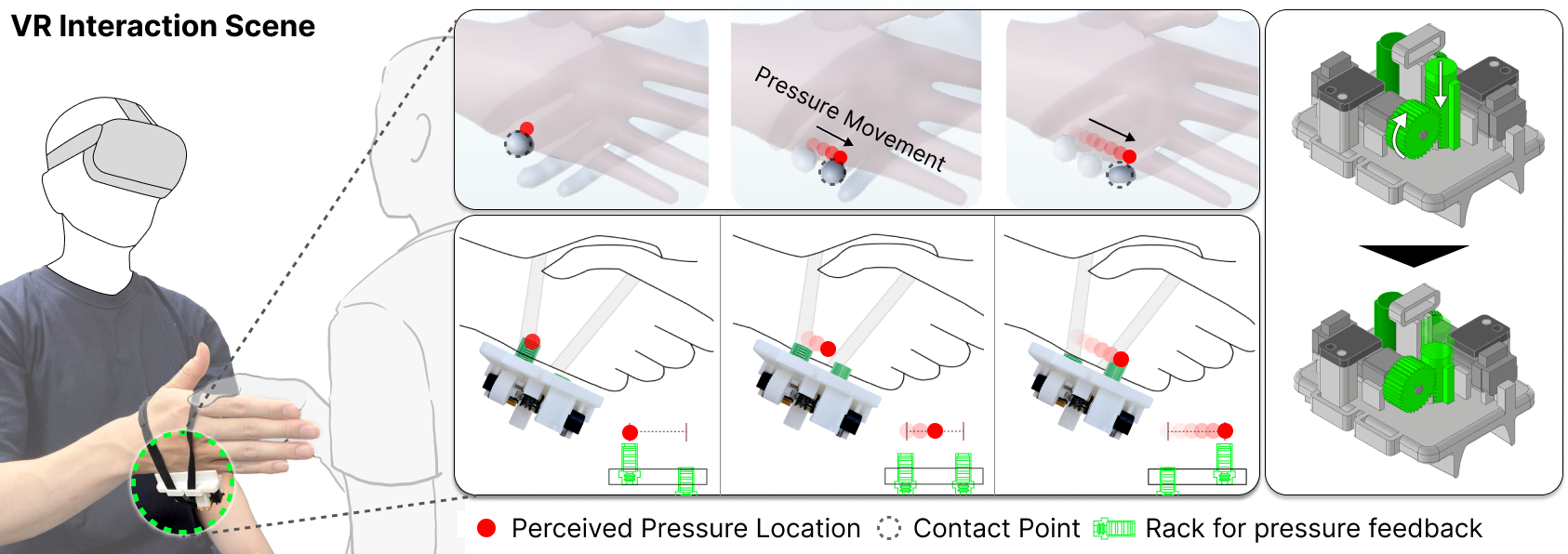
We propose a haptic interface, Moving-Press, enabling a pressure-based moving phantom sensation on the user’s hand. The moving phantom sensation refers to an illusory perception of a continuous tactile stimulus traversing between two discrete stimulation points. While this phenomenon has been studied in the context of vibrotactile feedback, it remains underexplored in the domain of pressure feedback. As integrating phantom sensation offers a promising approach to simplifying typically bulky pressure devices, employing this phenomenon enables more compact pressure rendering systems. Therefore, we investigated whether pressure movement could be induced using two fixed-positioned actuators by leveraging pressure-based phantom sensation. Our initial perception study validated the occurrence of pressure-based phantom sensations on the hand. Then, we examined how varying the indentation depth of each actuator influences the perceived location, and how the phantom sensation intensity differs from a single pressure stimulus. Finally, we proposed a rack-and-pinion-driven wearable haptic device and conducted a user study to identify an appropriate haptic rendering profile for producing natural pressure movement. The results demonstrated that temporal modulation of indentation depth using the proposed device successfully evokes pressure-based moving phantom sensation.
    @article{yoon2025moving,
      title={Moving-Press: Pressure-based Moving Phantom Sensation for Immersive VR Hand Interaction},
      author={Yoon, Sang Ho and Kwak, DongKyu and Seo, Kyungjin and Kim, Rachel},
      journal={Proceedings of the ACM on Interactive, Mobile, Wearable and Ubiquitous Technologies},
      volume={9},
      number={4},
      pages={1--24},
      year={2025},
      publisher={ACM New York, NY, USA}
    }